I fed years of my own writing into ChatGPT and asked for five Instagram captions about batching content. The first one opened with “Stop creating content from scratch every single day.”
It wasn’t bad. It was grammatically perfect, it flowed nicely, and it could have been written for literally anyone in my industry. That’s the bit that stings… it’s not wrong, it’s just nobody.
Jump to a bit of the video:
1:33 The test: years of writing into a free account
1:58 The caption it gave me back
4:04 Fix one: feed it the mess
5:37 When to skip fix one entirely
6:17 Fix two: your brand voice doc is doing nothing
8:29 Fix three: what you never sound like
10:04 Fix four: show it where it got you wrong
11:36 Fix five: turn corrections into rules
14:34 Full disclosure: it only gets to 90%
Want the master prompt from the video? Get the free brand voice master prompt here. Paste it into Claude or ChatGPT and it walks you through all five fixes as a guided interview.
The short version
To make AI sound like you, you need more than your published content. Uploading that gets you about a third of the way. These are the five fixes that got me the rest:
- Feed it your messy writing (transcripts, voice notes, rough drafts), not your polished posts.
- Swap the adjectives in your brand voice document for rules it can check.
- Give it a banned list of things you’d never say.
- Rewrite one piece of its bad output yourself and tell it why you changed it.
- Turn every correction into a permanent rule in that file. It’s the only fix that keeps working as you change.
Why does AI sound generic even after you upload all your content?
Uploading your content is only about a third of the job, and the advice you were given stopped there. It’s good advice… it’s just incomplete.
Because here’s the thing: I followed that advice properly, and it still didn’t sound like me. I set up a brand new free ChatGPT account and gathered years of my stuff: newsletters, captions, blog posts, anything I could find. Then I hit the first wall. A free plan project only took five source files when I ran this in September 2026, so I had to squash a LOT of documents into a few.
Then I asked for the captions. What came back was the beige thing at the top of this post.
Is ChatGPT or Claude better at sounding like you?
When I fed both of them years of my writing and asked for captions, Claude came out ahead. Neither of them nailed it on its own.
When I told ChatGPT to use the files (“based on what you know about me, do the same task”), it improved, so some of this is a prompting problem. I ran the same test in Claude and it did better again, partly because Claude let me upload more context and partly because Claude is a stronger writer out of the box.
And yes, I was on the free tier of both, and paid models are better. That’s true. It’s also not the answer, because paying more for a tool is worth nothing if you don’t know how to ask it for what you want.
What should you feed AI to teach it your voice?
Feed it your messy writing, not your published work. Your published content is probably the WORST sample of how you sound.
Think about what a finished post is. It’s you, then you editing yourself, then you second-guessing that edit, then you making it a bit more professional in case your old boss sees it on LinkedIn and judges you. By the time it goes live, most of what made it sound like you has been edited out.
The voice lives further back. It’s in the first draft. It’s in the messy note you scribbled while you were walking the dog and had the idea in the first place.
So I gathered about twenty pieces of properly unpolished writing:
- My YouTube transcripts, which are pure spoken word and sound more like me than anything I’ve ever typed.
- Meeting transcripts, for the same reason.
- Draft notes and rough ideas that never went anywhere.
- Notes about my business goals and my ideal customer, so it understood what I’m trying to do and who I’m talking to.
That last one matters more than people expect. Context about your business and context about your voice are two different things, and the model needs both.
It’s also why casual voice chats with AI work so well. Talk to it, then ask it to learn from the chat. That’s unpolished you… which is the good stuff.
When should you not feed AI your messy drafts?
If formal language is what your clients expect from you, skip this one and feed it your polished writing instead.
“Feed it the mess” gets repeated everywhere like it works for everybody… and it doesn’t. If you’re a lawyer, an accountant, or anyone whose clients expect formal language, your polished copy probably IS what you need to sound like. Your captions might not reflect your personal voice on purpose, and that’s a perfectly good choice.
This is a personal-brand tip. If your name is the business and you write fairly casually, it’s one of the biggest wins on this list. If not, use the polished stuff and move on to the next section, which applies to everyone.
Why don’t adjectives work in a brand voice document?
Because when a model reads “empathetic and approachable”, it doesn’t picture you. It pictures the average of every empathetic, approachable thing it’s ever read. You asked for the average, so you got the average.
Mine used to open: “Maggie Stara’s brand voice is fun, empathetic, approachable, authentic and self-reflective. The tone is casual and conversational…” I’m bored just reading it, and it’s my own document. It could describe any brand on the planet.
So I deleted every adjective and replaced them with rules a machine can check:
I use ellipses a lot, as a pause before a reveal, not just to trail off.
I put single words in capitals for emphasis, never a whole sentence.
I use British spelling, always.
I write at roughly an eighth-grade reading level.
I swap jargon for everyday words (say “making the most of your day”, not “optimising productivity”).
An adjective is a vibe. A rule is an instruction. You can check every one of those.
I’ve written about this one at length before, including the 2024 prompt I used to recommend and why I changed my mind about it, in my post on building a social media strategy with AI. If this is the section you needed, read that one next, because it goes deeper than I can here.
What should be on your AI banned list?
Anything you’d never say. A banned list often does more work than the description, because describing your voice nudges the model in a direction, and banning something shoves it.
A chunk of mine, for illustration:
- Never a long em dash. Ever. A comma, a full stop or a hyphen instead.
- No corporate language. No “circle back”, no “move the needle”, no “low-hanging fruit”. (That one gives me trigger vibes from my corporate days.)
- No internet reaction slang. No “let’s gooo”, no “chef’s kiss”, no “stop the scroll”.
That third one took me two corrections to work out. I asked for casual, and the model sailed straight past casual into a TikTok comment voice that’s nothing like how I talk. I fixed it by hand twice before I realised it needed to be a written rule.
Your list will keep growing… and that’s the system working, not a sign you set it up wrong.
How do you show AI where it got your voice wrong?
Rewrite one piece of its bad output yourself, give it both versions, and tell it what you changed and why.
Every voice document I’ve ever seen includes good examples. Here’s my best caption, do more of this. That’s useful, but it’s only half the picture, because the model still has to work out on its own what makes your good writing good.
So instead of binning that beige batching caption and starting over, I rewrote it:
“I used to sit down on a Monday with a blank Notion page and ‘plan the week’… which mostly meant staring at it until I felt bad enough to go and do the washing up instead.”
Content doesn’t actually take that long. Switching into ‘content brain’ every single day does. That’s the bit nobody tells you.
It’s not the 20 minutes of filming, it’s the 20 minutes before it, sitting there going “right, so what am I even posting today”… Batching just removes that part. One afternoon a month I sit down, get properly into the flow, and come out the other side with weeks of content done. Same brain, same lighting, same outfit even (nobody has ever noticed 😅).
Then the rest of the month I get to actually run my business instead of feeding the content machine. So it’s not really about being more organised. It’s about only having to have the hard thought ONCE
Send this to the friend who’s still writing captions at 11pm 💜
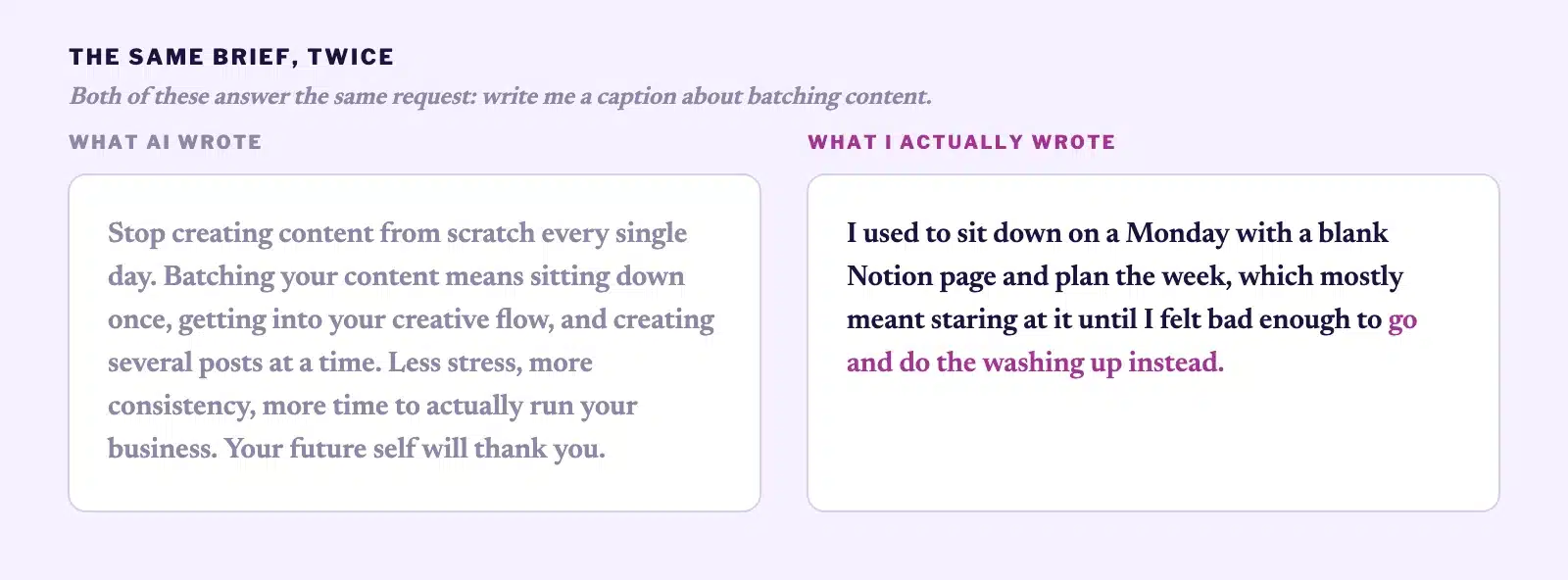
Then I told it why. Yours was advice, not a conversation. I always write from a shared experience, and there was no “I” anywhere in your version. You explained what batching is, and my audience already knows what batching is… they need to know why it matters. And the ending was generic AI speak.
And you don’t always have to know why you changed something. (I often can’t put it into words. I just know it’s wrong.) Change it anyway, hand both versions over, and let the model work out the rule. It’s very good at that.
How do you stop correcting AI for the same thing twice?
Paste your corrected version back in, ask what rule it should have followed, and tell it to add that rule to your brand voice file. Not to remember it for this chat. To add it to the file.
This is the fix that matters most, because everything above it is a one-off. You do it, things improve, and then it slowly goes stale as you change.
I got this wrong for ages. AI would write a newsletter, I’d paste it into Flodesk, fix it there, and send it. The corrections lived in the sent email and nowhere else. So the model made the same mistakes the next week, entirely reasonably, because nobody had told it otherwise.
Now the loop is:
- Paste my corrected version back in.
- Ask: look at what I changed and tell me what rule you should have followed.
- Tell it to write that rule into my brand voice file.
- Tell it to update anywhere else that rule needs to live.
Or paste it in as one prompt:
Here’s my corrected version. Look at what I changed and tell me what rule you should have followed. Then add that rule to my brand voice file, and update anywhere else that rule needs to live.
That last step is the one people skip. I have separate setups for captions, emails and video scripts, because how I write changes depending on what the writing is for. If a voice rule changes and only one of them gets updated, you end up with two versions of yourself that disagree.
Claude is very good at catching this. It’ll stop and say there’s a rule here and a rule there, which one do you want me to follow… which more or less forces you to keep things tidy.
If none of that multiple-setup stuff is on your radar yet, don’t worry about it. One really solid brand voice file already puts you ahead of most people using these tools.
The whole thing comes down to one line: if you’re correcting the same thing twice, that’s a rule you haven’t written down yet.
How close does AI get to sounding like you?
About 90%, in my experience, and I’d be suspicious of anyone who tells you otherwise.
Full disclosure, because I don’t want to oversell this… that last 10% is still mine to write. It still means I’m editing rather than staring at a blank page, and I’ll take that trade every single day.
I still read EVERYTHING before it goes out, and I still rewrite my hooks by hand, because the opening carries the most personality and it needs a human. I also get AI to interview me whenever it clearly doesn’t have the real-life example it needs.
And it should never be fully hands-off, for a reason that has nothing to do with the technology: I keep changing. My business keeps changing. Something that was a rule last year may not be a rule now. A system that runs without you is a system slowly describing someone you used to be.
What should you do first?
Go and open your brand voice document, if you have one. Delete every adjective in it. Replace them with five things that are true about how you write and that somebody else could check.
Then, the next time AI writes something for you and you change it, don’t just fix it and move on. Paste your version back, ask it what rule it should have followed… and put the answer in the file.
That’s the habit. Everything else is setup.
If you’d rather not build the file from a blank page, the free brand voice master prompt walks you through all five fixes as an interview. And if you’re starting further back than all this, social media marketing for beginners is the place to begin.
Originally published October 2026.